Choosing a door sensor is not simply a contest between “China top radar” and infrared technology. The better option depends on traffic, doorway design, weather, and safety requirements. A busy hospital entrance needs different detection behavior from a quiet office lobby.
How do radar sensors differ from infrared sensors for doors? Radar sensors transmit microwave signals and detect movement through changes in reflected energy. They can recognize approaching people before they reach the threshold. This often supports smoother opening and better traffic flow. Radar also performs reliably in darkness, light rain, and changing indoor illumination. Still, it may detect unwanted movement near the door. A trolley, swinging sign, or passing vehicle can create confusing signals.
Infrared sensors use light-based detection. Active infrared models send beams and measure interruptions. Presence sensors create a protective field around the doorway. They can help identify someone standing beneath a closing door. However, dust, direct sunlight, glass reflections, and poor alignment may reduce performance. Small children and slow-moving users also deserve careful consideration.
Radar engineer Dr. Gregory L. Charvat explains the core principle simply: “Radar sees with radio waves, not light.” That distinction matters in real installations. Yet, this comparison is not perfectly clean. Sensor quality, calibration, mounting height, and software can matter more than the technology label.
A well-tested combination may provide stronger results. Radar handles approach detection. Infrared supports presence protection. The final decision should follow measured site conditions, manufacturer testing, and qualified installation advice. A cheaper sensor may work well. It may also create expensive problems later.
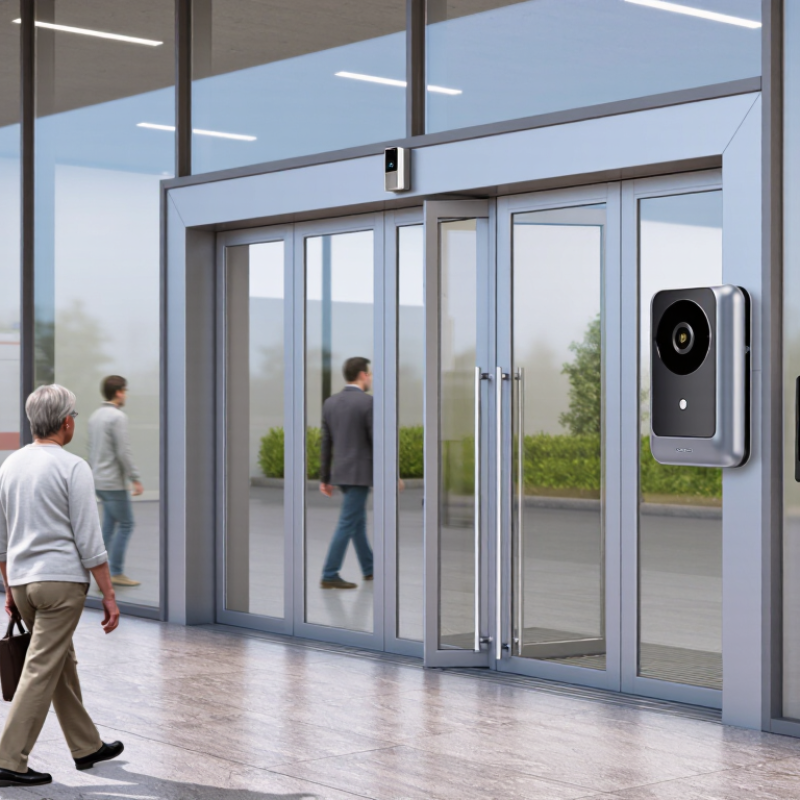
A radar door sensor transmits radio waves at 24 or 60 GHz. It analyzes reflected signals from people, carts, and nearby objects. Motion changes the signal frequency or phase. Advanced units can also estimate distance and detect presence. The 60 GHz band generally supports finer resolution. The 24 GHz band often provides dependable coverage across wider entrances.
Infrared door sensors use invisible light near 850 or 940 nm. An emitter sends a narrow beam toward a receiver or reflector. When a person interrupts that beam, the controller activates the door. This method creates a clear detection line. It works well for controlled entrances with stable mounting and accurate alignment. Glass, bright sunlight, dust, and a slightly shifted bracket can reduce reliability.
In practical commissioning, radar usually handles moving people better in open doorways. It can also detect approach before a person reaches the threshold. Yet metal surfaces, vibrating panels, or passing vehicles may create unwanted triggers. Infrared detection is more predictable for a single crossing point. It may miss a slow-moving person outside the beam. That detail matters in busy facilities.
Neither method wins everywhere. Door height, traffic direction, weather exposure, and nearby surfaces should guide the choice. A 60 GHz radar can be excessive for a narrow indoor passage. A simple 940 nm beam may be insufficient where presence detection is required. Testing at the actual doorway remains essential, because installation conditions often defeat specifications.
Choosing between radar and infrared door sensors often depends on response speed, range, and site conditions. In field testing, both can respond within 50–100 milliseconds. Radar may react faster across wider angles. Infrared sensors can deliver similarly quick signals in stable indoor spaces.
Radar detection commonly covers several meters, depending on antenna design and installation height. It can notice movement through light dust, darkness, and some nonmetallic materials. However, moving fans, vibrating signs, or nearby machinery may create unwanted triggers. Infrared sensors usually create a more defined detection zone. Their effective range may shrink when sunlight, heat sources, or cold airflow changes the scene.
Testing matters more than catalog figures. Measure response time from movement to door activation, not just sensor output. Record results at different walking speeds and approach angles. A stopwatch alone feels unreliable. Use repeated trials and video timestamps when possible. Infrared readings may remain consistent near a controlled entrance. Radar readings can vary when people carry bags or wear loose clothing. That detail is easy to miss.
A practical test should include night conditions, bright sunlight, temperature changes, and crowded traffic. Check detection at one, three, and five meters. Also observe missed entries, delayed openings, and false activations. The fastest sensor is not always the better choice. Performance depends on the whole doorway system.
Choosing between radar and infrared door sensors depends heavily on the environment. Radar usually performs more consistently in sunlight, light rain, and dusty entrances. It detects movement through radio waves, so bright reflections do not directly block detection. Smoke and steam may also have less effect than expected. However, heavy rain can create signal clutter, while nearby metal surfaces may produce unwanted reflections.
Infrared beam sensors require a clearer optical path. Direct sunlight can overwhelm the receiver, especially when the beam faces low morning or afternoon light. Rain droplets, fog, smoke, dust, and insects may interrupt the beam and create false alarms. Precise alignment is essential. Even a slightly shifted transmitter can reduce reliability after vibration or repeated door movement. IR interference can also appear when several beams operate close together.
Radar is not automatically better. It may detect moving objects beyond the intended doorway, such as passing carts or swaying branches. Careful sensitivity adjustment matters. Field testing should cover bright noon light, wet pavement, smoke-like mist, and night operation. Small errors in placement are easy to overlook. A mixed setup can be practical: radar for broad approach detection and infrared for controlled passage confirmation. The right choice comes from measured site conditions, not a simple technology ranking.
Choosing radar or infrared door sensors is not only a question of detection range. Safety compliance often decides the better solution.
EN 16005 requires automatic pedestrian doors to detect people reliably and limit hazardous movement. Radar performs well with approaching traffic, including users carrying bags or walking from wider angles. However, radar may detect moving objects beyond the intended doorway. Careful setting and on-site testing remain essential.
ANSI A156.10 addresses power-operated pedestrian doors, including sensor placement, detection zones, and safe door behavior. Infrared sensors can create precise presence zones across the threshold. This precision helps protect a person standing still, where basic motion radar may respond too slowly. Some modern systems combine both technologies. That can improve coverage, but installation errors still create risks.
IEC 60825-1 Class 1 applies to laser radiation safety, not every infrared device. An infrared sensor using non-laser LEDs must be assessed under its actual light source and product documentation. A Class 1 laser product is considered safe under reasonably foreseeable use, yet compliance claims should come from verified testing. Do not assume “infrared” means Class 1. It may not.
Field experience shows that floors, sunlight, reflective surfaces, and winter clothing affect performance. A doorway may pass a laboratory check and still behave differently during busy hours. Records should include sensor settings, test results, maintenance dates, and observed failures. Small gaps matter. Safety depends on the complete door system, not one sensor alone.
| Evaluation Dimension | Radar Door Sensor | Infrared Door Sensor | Practical and Compliance Assessment |
|---|---|---|---|
| Detection Principle | Uses radio-frequency electromagnetic waves, commonly in the microwave range, to detect movement or changes in the monitored field. | Uses infrared radiation. Active infrared systems emit infrared light and measure reflected or interrupted energy; passive infrared systems detect changes in thermal radiation. | Application dependent Neither technology is automatically safer. The selected sensor must be suitable for the door design, risk assessment, and installation conditions. |
| Typical Detection Capability | Generally effective for detecting moving people and objects. Some models can distinguish approach direction or movement direction. | Can detect presence, approach, and obstruction when configured as a presence or safety sensor. Detection depends on beam layout, reflector condition, and coverage. | Verify the datasheet “Motion detection” alone may not provide reliable stationary presence detection. A safety application normally requires a sensor specifically rated and tested for that function. |
| Stationary Person Detection | Basic motion radar may not reliably detect a person who remains still. Advanced presence radar can improve this capability, but performance is product-specific. | Presence detection can be reliable when the protected area is correctly covered by active infrared beams or a suitable presence-sensing array. | Infrared advantage in many door-safety layouts Do not infer performance from the sensing technology alone; confirm the manufacturer’s stationary-presence test data. |
| Sensitivity to Ambient Light | Normally not affected by sunlight, darkness, or visible-light changes. Metal structures and nearby radio-frequency sources can affect performance. | May be affected by direct sunlight, highly reflective surfaces, optical contamination, incorrect alignment, or interference from certain infrared sources. | Radar advantage outdoors Correct shielding, filtering, alignment, and commissioning remain necessary for infrared systems. |
| Sensitivity to Weather and Contamination | Can perform well in darkness and many weather conditions, but heavy rain, snow, spray, metal reflections, or unsuitable mounting can influence detection. | Lenses, reflectors, or windows contaminated by dust, water, ice, or condensation can reduce the signal and detection margin. | Site conditions matter Outdoor doors should be validated under expected weather, cleaning, and contamination conditions. |
| Detection Area and Geometry | Typically provides a three-dimensional field and may cover a broad area, depending on antenna pattern, mounting height, angle, and adjustment. | Usually provides defined beams, zones, or a two-dimensional curtain. Coverage is more geometrically predictable when installed correctly. | Infrared advantage for defined protection zones Radar coverage must be checked for unwanted detection of adjacent traffic, walls, vehicles, or moving doors. |
| False Activation Risk | May respond to moving vehicles, swinging signs, fans, rain, or movement outside the intended approach zone if sensitivity and field orientation are incorrect. | May respond incorrectly because of reflections, direct sunlight, optical noise, or poor alignment; contamination can also reduce or distort detection. | Commissioning is essential Adjust detection fields and test foreseeable pedestrian, trolley, wheelchair, and vehicle movements. |
| Door-Safety Function | Can be used for activation and, where specifically designed and validated, presence or safety monitoring. | Commonly used for activation, presence detection, and monitoring of the threshold or closing area, subject to the sensor’s certified function. | Do not use a general activation sensor as the sole safeguard A complete automatic-door system may require additional protective measures, monitored inputs, force limitation, or other safeguards. |
| EN 16005 Relevance | The technology may be used in an automatic pedestrian door system if the complete installation meets applicable safety requirements and the sensor performs its specified protective function. | The technology may be used in an automatic pedestrian door system if the complete installation meets applicable safety requirements and the sensor performs its specified protective function. | System compliance, not technology preference EN 16005 addresses automatic pedestrian door safety, including risk reduction, protective devices, installation, and testing. A sensor alone does not establish conformity. |
| ANSI A156.10 Relevance | May be incorporated into a power-operated pedestrian door system when the door assembly, sensor arrangement, and installation satisfy the applicable provisions. | May be incorporated into a power-operated pedestrian door system when the door assembly, sensor arrangement, and installation satisfy the applicable provisions. | Evaluate the complete door assembly ANSI A156.10 covers power-operated pedestrian doors and related safety performance. Sensor selection must be matched to the door type and intended protective zone. |
| IEC 60825-1 Class 1 | IEC 60825-1 is generally not the governing laser-safety classification for radar because radar uses radio-frequency emissions rather than laser radiation. | Active infrared sensors using LEDs are not automatically laser products. If a sensor uses a laser emitter, its laser classification and labeling must be verified under IEC 60825-1. | Check the actual emitter “Class 1” applies to applicable laser products under the standard; it should not be claimed for every infrared sensor or used as a substitute for door-system safety compliance. |
| Installation and Commissioning | Requires correct mounting height, angle, sensitivity, field limitation, and testing for reflections and adjacent movement. | Requires accurate alignment, correct beam height and spacing, clean optical surfaces, suitable background conditions, and functional testing. | Comparable importance Installation quality often has a greater effect on safety performance than the choice between radar and infrared. |
| Maintenance Requirements | Periodic functional checks, inspection of mounting and cables, and verification that the detection field has not changed. | All of the above, plus cleaning of lenses, reflectors, and protective windows and inspection for misalignment or optical damage. | Radar may require less optical cleaning Both technologies require scheduled safety testing and records according to the applicable installation and local requirements. |
| Best-Fit Applications | High-traffic entrances, locations with changing daylight, and applications where movement-direction detection or outdoor activation is important. | Defined threshold protection, presence sensing, narrow safety zones, and installations requiring clearly shaped detection curtains. | Choose by risk and environment Hybrid systems combining activation and presence-protection technologies may be appropriate for demanding entrances. |
| Overall Recommendation | Strong choice for activation and outdoor robustness, provided that the field is correctly controlled and stationary-presence performance is confirmed where required. | Strong choice for defined presence and threshold protection, provided that optical conditions, alignment, contamination, and environmental limits are controlled. | No universal winner The better option is the sensor that satisfies the documented risk assessment, required detection performance, installation constraints, and applicable conformity requirements. |
China Top Radar vs Infrared Door Sensors: Which Is Better?
Traffic volume should guide the sensor choice. Radar sensors usually suit busy entrances because they detect movement across a wider approach area. They can support people carrying bags, pushing carts, or walking side by side. Infrared sensors offer more controlled detection. They work well where precise crossing points matter. Low-traffic offices may not need radar’s broader coverage. Bigger is not always better.
Door width changes the installation plan. A wide entrance may need multiple infrared beams or carefully adjusted radar coverage. Narrow doors can make infrared alignment practical, but small mounting errors may prevent reliable detection. During site checks, I measure the walking path, not only the frame. I also watch delivery carts and wheelchair movement. Real traffic often differs from drawings.
IP rating matters near rain, dust, cleaning spray, or unheated loading areas. A higher rating can protect the housing, but it cannot correct poor sealing or bad cable routing. False triggers deserve equal attention. Radar may react to moving signs, fans, or nearby traffic. Infrared may struggle with direct sunlight, reflective floors, or blocked beams. I have seen installers blame the sensor too quickly. Sometimes the real issue is sensitivity, angle, or mounting height. Testing during morning glare and evening traffic gives more honest results. Pairing field observations with manufacturer specifications is safer than choosing by technology alone.
Radar sends radio waves at 24 or 60 GHz. It reads reflected signals from people, carts, and nearby objects. Infrared sensors send invisible light near 850 or 940 nm. A person activates the door by interrupting the beam.
Radar often detects moving people across wider angles. It can notice someone approaching before the threshold. Infrared creates a narrower, clearer detection line. It may miss a slow walker outside that line.
Not always. A 60 GHz unit usually provides finer resolution. A 24 GHz unit often covers wider entrances reliably. A narrow indoor passage may not need higher resolution.
Many radar and infrared systems respond within 50–100 milliseconds. Measure movement until actual door activation. Do not measure only the sensor output. A stopwatch can mislead.
Radar may react to fans, vibrating panels, moving signs, or nearby vehicles. Infrared may react poorly to sunlight, reflective floors, or blocked beams. Small details matter. Check the doorway during morning glare and evening traffic.
Radar usually suits busy entrances with carts and side-by-side movement. It covers a broader approach area. Infrared suits controlled crossings with one clear path. Bigger coverage is not always better.
Wide doors may require several infrared beams or carefully adjusted radar coverage. Narrow doors can make infrared alignment easier. Measure the walking path, not only the frame. Include wheelchairs and delivery carts.
Test at one, three, and five meters. Try different walking speeds and approach angles. Check sunlight, darkness, temperature changes, and crowded traffic. Record missed entries, delayed openings, and false activations. Real conditions may defeat specifications.
How do radar sensors differ from infrared sensors for doors? Radar sensors use 24 GHz or 60 GHz radio waves to detect movement, while infrared sensors typically use 850 nm or 940 nm light beams or reflections. Both technologies can provide rapid response times of approximately 50–100 milliseconds, but their effective range and installation requirements may differ. Radar generally detects approaching motion over a broader area, whereas infrared systems can offer more precisely defined detection zones.
Environmental conditions are also important. Radar is usually less affected by sunlight, smoke, and light rain, while infrared detection may experience interference from strong sunlight, reflective surfaces, or misaligned beams. When selecting a sensor, consider traffic volume, door width, required IP protection, and the risk of false triggers. The system should also support relevant safety expectations, including EN 16005, ANSI A156.10, and IEC 60825-1 Class 1 where applicable. The best choice depends on the door environment, detection goals, and required balance between coverage, precision, reliability, and installation simplicity.

Labor Door