Loading platforms in China often work under demanding conditions. Dust, rain, vibration, and frequent vehicle movement can affect emergency-stop performance. A reliable inspection must examine more than the red button. It should confirm the complete safety circuit, stopping response, reset behavior, and visible equipment condition. This article introduces practical methods for checking emergency stops on loading platforms, using manufacturer instructions, risk assessments, and documented maintenance procedures.
How to test the emergency stop on a loading platform? Begin with a controlled area and trained personnel. Remove unnecessary workers from the platform and keep the loading zone clear. Check the button, protective cover, labels, wiring, and control panel for damage. Then operate the platform under safe conditions and press the emergency stop. The lifting, lowering, or traveling movement should stop promptly without unusual delay. Do not stand beneath raised equipment.
The test is not complete when movement stops. Try the approved reset method and confirm that the platform does not restart automatically. A separate start command should be required. Check whether alarms or indicators show the emergency condition clearly. Record the date, test result, equipment identity, and any corrective action. Small details matter.
In real inspections, rushed testing can produce misleading results. A button may click correctly while its contact block remains faulty. Sometimes operators test only an unloaded platform, although changing loads can reveal different stopping behavior. That weakness deserves attention. Testing frequency should follow the equipment manual, site procedures, and competent safety advice. If any response seems slow, inconsistent, or unclear, remove the platform from service until qualified technicians investigate it.
China Top Loading Platforms: How to Test Emergency Stops?
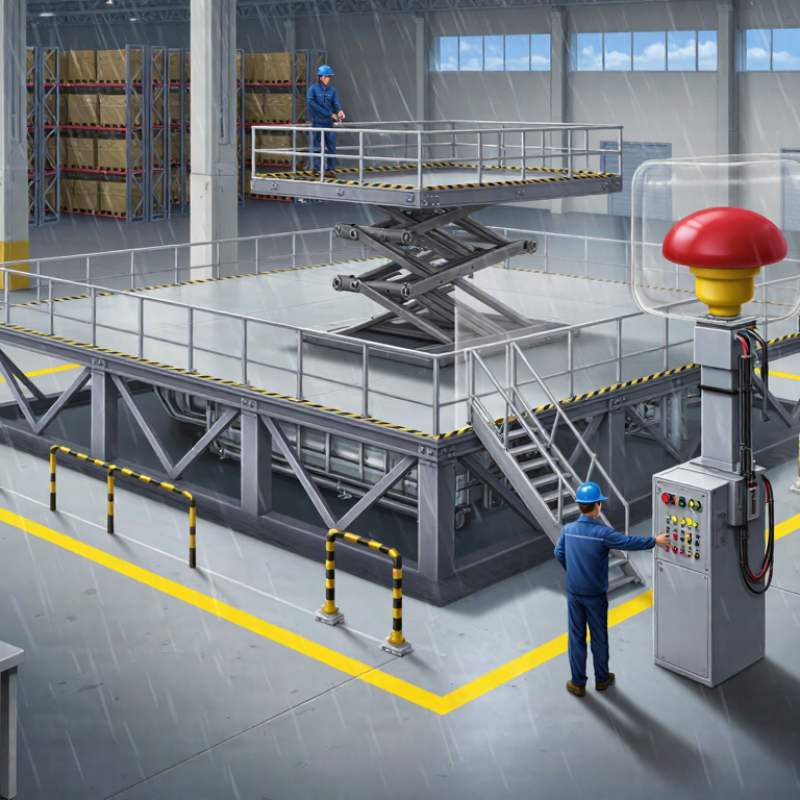
Top-loading platforms need an emergency stop system that is visible, reachable, and reliable. Its main components include red mushroom actuators, yellow backgrounds, safety relays, dual-channel wiring, contactors, and manual reset controls. Some platforms also use pull-wire switches along long access areas. Each device should stop hazardous movement, such as loading arms, pumps, or powered access equipment.
ISO 13850 requires emergency stops to use a maintained action and prevent automatic restarting. IEC 60204-1 also emphasizes reliable control circuits and fault detection. During testing, inspect every actuator for damage, then activate each one separately. Confirm that all relevant motion stops without abnormal delay. Check that stored pressure or electrical energy does not create unexpected movement. Release the actuator, reset the system manually, and verify that movement does not restart automatically.
A pass result is not proof of perfect protection. A common weak point is a reset button positioned inside the hazard zone. Testers should also simulate a broken channel, loose connection, or failed contactor when the design allows it. The U.S. Bureau of Labor Statistics recorded 5,283 fatal work injuries in 2023, while UK HSE reported about 0.6 million workplace injuries in 2023/24. These figures cover all industries, not only loading platforms, but they show why functional testing matters. Record the test date, device location, stopping response, defects, and corrective action. Keep the record specific. Vague notes hide recurring failures.
China Top Loading Platforms: How to Test Emergency Stops?
Before testing an emergency stop, prepare the platform and its surroundings carefully. The International Labour Organization estimated 2.93 million work-related deaths worldwide in 2019. Many incidents involve unsafe equipment, poor procedures, or weak supervision. A controlled test begins with a documented risk assessment, trained personnel, and a clear exclusion zone around the top loading platform.
Remove vehicles, cargo, tools, and unnecessary workers from the operating area. Check that guards, access gates, warning signs, and communication devices work correctly. Inspect the emergency-stop buttons for damage, obstruction, or loose mounting. Review the platform manual and relevant requirements, including ISO 12100, ISO 13850, and IEC 60204-1. Isolate unexpected energy sources when required. Do not bypass safety circuits.
Test with the platform unloaded first, unless the approved procedure specifies otherwise. Confirm that pressing the emergency stop stops hazardous movement promptly and safely. Verify that the control system prevents automatic restarting after release. The reset should require deliberate action. Then inspect the platform for drift, unusual noise, or hydraulic leakage. Record the test time, button location, result, and corrective action. A rushed test is not a real test. We sometimes trust the button too much. It is only one layer of protection, not a substitute for guarding, training, or safe operating procedures. Any failed result should keep the platform out of service until a competent technician investigates it.
| No. | Preparation Area | Safety Preparation Before Testing | Test Method | Expected Result / Acceptance Criteria | Record |
|---|---|---|---|---|---|
| 1 | Risk assessment | Review the machine risk assessment, operating instructions, electrical drawings, and emergency-stop circuit design. Confirm that testing will not create additional hazards. | Conduct a documented pre-test review with the responsible operator and maintenance or safety personnel. | The test sequence, hazards, controls, and responsible persons are clearly defined before power is applied. | Review date and signatures |
| 2 | Work authorization | Notify affected workers, drivers, loading personnel, and control-room staff. Establish a controlled test area and prevent unauthorized access. | Use barriers, warning signs, or a designated safety observer around moving equipment and the top-loading platform. | Only authorized personnel remain inside the test zone, and everyone understands the test signal and stop condition. | Permit or briefing record |
| 3 | Vehicle and loading status | Remove vehicles from the loading position unless the approved procedure specifically requires a controlled vehicle interface test. Stop product transfer and close relevant valves. | Verify visually that no vehicle movement, loading operation, transfer operation, or incompatible maintenance activity is in progress. | The platform is in a safe test state, with no simultaneous loading or traffic movement that could be affected by the emergency stop. | Status checklist |
| 4 | Mechanical condition | Inspect stairs, walkways, guardrails, gates, hinges, moving arms, loading bridges, and access points. Remove loose tools and materials. | Perform a visual inspection before energizing the equipment. Do not place hands or body parts near moving components. | No damaged guard, obstruction, trip hazard, unstable component, or condition that could cause injury during an unexpected stop. | Inspection findings |
| 5 | Electrical and energy control | Identify electrical, hydraulic, pneumatic, gravity, and stored mechanical energy. Apply lockout/tagout whenever guards must be removed or anyone could enter a danger zone. | Verify isolation and zero-energy conditions for intrusive work. For a functional test, restore energy only under the approved controlled procedure. | No person is exposed to hazardous energy, and the selected test method matches the site energy-control procedure. | Isolation verification |
| 6 | Emergency-stop devices | Locate every emergency-stop pushbutton, pull-cord, or other approved actuator. Check accessibility, visibility, identification, physical damage, and unobstructed access. | Inspect each device without operating it first. Confirm that the actuator can be reached quickly from the relevant work position. | Each device is clearly identifiable, readily accessible, mechanically intact, and suitable for the hazard and operating environment. | Device identification list |
| 7 | Communication and observation | Assign one person to operate the emergency stop and another person to observe the platform and connected equipment, where the layout requires it. | Confirm verbal or radio communication before each test. Agree on the command to start, stop, and abort the test. | The test can be stopped immediately if an unsafe condition, unexpected movement, noise, leak, or loss of communication occurs. | Personnel and communication method |
| 8 | Controlled operating condition | Run the equipment only in the minimum operating mode necessary for the test. Keep personnel outside the movement envelope and away from pinch, crush, and shear points. | Use a no-load or approved low-risk condition where practicable, while maintaining all required guards and interlocks. | The test condition is stable, controlled, and representative enough to verify the emergency-stop function without exposing people to unnecessary risk. | Operating condition |
| 9 | Emergency-stop activation | Confirm that the emergency stop is intended for stopping hazardous motion or operation, not for routine stopping or isolation for maintenance. | Start the approved function, then actuate one emergency-stop device at a time. Observe all affected functions and connected equipment. | Hazardous motion or operation stops as designed, and the stop command reaches all equipment identified in the risk assessment. No unexpected restart occurs. | Pass / fail and observations |
| 10 | Reset and restart prevention | Check the reset device and restart controls. Ensure the area is clear before any restart attempt. | Release or reset the emergency-stop actuator according to the equipment design, then attempt a restart from the normal control station. | Resetting the emergency stop does not by itself restart the equipment. A separate, intentional start command is required after the area is confirmed safe. | Restart test result |
| 11 | Post-test condition | Inspect the platform, controls, cables, hoses, valves, indicators, and emergency-stop actuators after testing. | Check for damage, abnormal noise, leakage, fault indication, incomplete reset, or residual movement. | The equipment remains in a safe condition, all required functions are restored, and no defect is left unreported. | Post-test inspection |
| 12 | Defect response and release | If any emergency stop fails, isolate the equipment, label it out of service, and notify the responsible supervisor or maintenance authority. | Do not bypass, bridge, or disable the emergency-stop circuit to return the platform to operation. | The platform is released only after repair, verification, and documented approval by authorized personnel. | Corrective-action record |
China Top Loading Platforms: How to Test Emergency Stops?
Before testing a top loading platform, review the operating manual and applicable Chinese safety requirements. Assign a trained technician to lead the inspection. Keep vehicles, operators, and bystanders outside the movement area. Keep people clear. Check the emergency stop button, wiring, labels, and protective guards for visible damage. The platform should be empty and positioned safely before the test begins.
Notify nearby workers that the emergency stop test is starting. Switch on the platform under normal operating conditions. Move it slowly, then press the emergency stop firmly. The lifting or moving action must stop immediately. Listen for unusual sounds and check that stored movement does not continue. Test every emergency stop location separately. A single successful button press does not prove the entire circuit works.
After activation, confirm that normal controls cannot restart the platform. Release or reset the emergency stop only according to the equipment instructions. Then test a controlled restart from a safe position. If the platform moves unexpectedly, stop the procedure and isolate the equipment for qualified repair.
Do not bypass the circuit for convenience. Record the date, button tested, stopping response, and any defect found. The record may seem routine, but missing details can weaken future inspections. Repeating the test under pressure is tempting; it is also where small mistakes appear.
China Top Loading Platforms: How to Test Emergency Stops?
Before testing, clear the platform and secure the surrounding area. Only trained personnel should operate the controls. Check the emergency-stop buttons, wiring, labels, and protective covers for visible damage. Confirm that the platform is stable and unloaded. Keep a safe distance from moving parts.
Press the emergency stop during a controlled lifting or lowering cycle. The platform should stop promptly, without unexpected drifting or restarting. Check that hydraulic movement, electrical drives, and related functions have stopped. Watch the platform, not only the indicator light. A light can work while a mechanical fault remains. Repeat the test from each emergency-stop location, including the ground and platform controls.
Reset the button according to its design, such as twisting or pulling it. Resetting must not restart the platform automatically. Select a normal operating control and issue a new command. The platform should respond only after this deliberate restart action. Test the same sequence in both travel directions when permitted by the operating manual. Record the test date, button location, stopping response, reset method, and any abnormal noise. A rushed check may miss delayed movement. That weakness deserves attention. If the platform moves after reset, fails to stop, or restarts unexpectedly, remove it from service and request inspection by a qualified technician. Follow the manufacturer’s instructions and applicable local safety requirements.
On a China top loading platform, test every emergency stop before loading begins. The U.S. Bureau of Labor Statistics recorded more than 1,000 fatal injuries in transportation and material-moving occupations during 2023. This figure shows why simple control checks matter. Press each red mushroom button, then confirm hydraulic motion stops immediately. Check the platform, ladder, conveyor, and remote controls. The stop circuit should require a deliberate reset before movement returns. ISO 13850 recommends that emergency-stop functions remain available, clearly identified, and manually reset.
Common faults include damaged contacts, loose wiring, moisture inside control boxes, and failed safety relays. A stop button may feel normal but still fail electrically. That is dangerous. Inspect terminal tightness and measure circuit continuity with power isolated. Check for unexpected movement after reset. A platform that restarts automatically needs corrective action before use. Replace damaged buttons, dry and seal enclosures, and repair wiring with approved components. Never bypass a safety circuit to keep production running. It saves minutes, perhaps. It can create a serious exposure. Maintenance records should include the test date, button location, fault found, corrective action, and technician’s name. Periodic verification should follow the manufacturer’s instructions and applicable standards, because one successful test does not prove long-term reliability.
It stops hazardous movement quickly during an abnormal event. This may include lifting equipment, pumps, loading arms, or powered access systems. It is one safety layer, not complete protection.
Common parts include red mushroom actuators, yellow backgrounds, safety relays, dual-channel wiring, contactors, and manual reset controls. Long access areas may also use pull-wire switches. Each device should be visible and reachable.
Complete a documented risk assessment before testing. Train the people involved. Create a clear exclusion zone around the platform. Remove vehicles, cargo, tools, and unnecessary workers. Test the unloaded platform when the approved procedure allows it.
Check each actuator for cracks, obstruction, loose mounting, or damaged labels. Inspect guards, gates, warning signs, wiring, and protective covers. Confirm that communication devices work. Do not bypass safety circuits.
Activate each emergency stop separately during a controlled movement. Confirm that all related motion stops without abnormal delay. Watch for hydraulic drift, electrical movement, leakage, or unusual noise. Do not rely only on an indicator light.
The platform must not restart automatically after reset. Resetting should require deliberate action, such as twisting or pulling the actuator. A separate operating command should be needed to restart movement. That distinction matters.
When the design permits, simulate a broken channel, loose connection, or failed contactor. Check whether the system detects the fault and prevents hazardous movement. A reset button inside the hazard zone is a serious weakness. The design may pass, yet still deserve review.
Record the test date, device location, stopping response, reset method, defects, and corrective action. Use specific descriptions, such as “platform control, delayed stop, loose terminal.” Vague notes can hide repeated failures. We sometimes trust the button too much.
Keep the platform out of service immediately. Prevent further operation until a qualified technician investigates it. A failed stop, unexpected restart, or delayed movement requires attention. Do not treat a rushed check as proof of safety.
This guide explains How to test the emergency stop on a loading platform? It introduces the main emergency stop components, including push buttons, safety circuits, control relays, alarms, and motor or hydraulic shutdown devices. Before testing, personnel should review the operating instructions, clear the work area, check for visible damage, notify nearby workers, and ensure the platform is unloaded and in a safe position. Testing should be performed by trained personnel under controlled conditions, with suitable protective equipment and proper communication.
The procedure includes activating the emergency stop during a safe operating condition and confirming that hazardous movement and related power functions stop immediately. The emergency indicator and control circuit should also respond correctly. Afterward, the button must be reset according to the equipment design, while verifying that the platform does not restart automatically. Normal operation should resume only after a deliberate restart command. The guide also covers common faults, such as damaged buttons, loose wiring, failed relays, delayed stopping, or ineffective resets, along with corrective actions including inspection, repair, replacement, and documented retesting.

Labor Door